Wooden Toys for Toddlers: A Simple Guide to Safe, Screen-Free Play
Walk into any toy store today and you'll be surrounded by flashing lights, loud sound effects, and shelves of plastic packaging promising to make your toddler "smarter" or "happier." It's a lot of noise literally. And somewhere in the middle of that noise, a quieter, simpler category has been making a comeback: wooden toys for toddlers.
If you've ever picked up a well-made wooden toy, you know the difference immediately. It feels solid. It has weight. It doesn't need batteries to hold a toddler's attention for twenty minutes straight. There's a reason parents, pediatricians, and early childhood educators keep circling back to wood as the material of choice for the earliest years of play.
 |
What Makes Wooden Toys for Toddlers Different
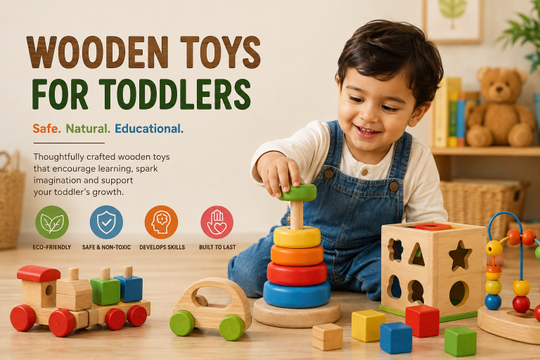
Toddlers learn almost everything through touch, repetition, and imagination — not through pressing a button and watching something happen automatically. Wooden toys for toddlers are built around that idea. They don't do the playing for the child; they give the child room to do the playing themselves.
A wooden block isn't just a block. One day it's a tower, the next it's a phone, the day after that it's dinner for a stuffed bear. That kind of open-ended play builds problem-solving skills, patience, and creativity in a way that pre-programmed electronic toys simply can't replicate. And because toddlers wooden toys are usually finished with non-toxic paints and food-grade sealants, parents don't have to worry about what happens when a toy inevitably ends up in a toddler's mouth which, let's be honest, it will.
There's also the safety angle that matters more than people realize. Wood doesn't splinter into sharp plastic shards when it breaks. It doesn't need button-cell batteries that pose a swallowing hazard. And it tends to survive years of rough love, getting handed down from one sibling to the next, or even passed on to a cousin's kid a decade later.
Animal Toys for Toddlers: Small Shapes, Big Learning
Among the most popular categories are animal toys for toddlers and it's easy to see why. Toddlers are naturally drawn to animals long before they can name them. A set of wooden farm animals or a jungle safari set does double duty: it's a toy, and it's also an early vocabulary lesson. Parents often notice their toddler naming animals, mimicking sounds, and building little story worlds a lion visiting a farm, a cow riding in a truck all from a handful of carved wooden pieces.
These sets are also great for sensory development. Different shapes, textures, and sizes help toddlers refine their grip and hand-eye coordination, which are quietly important skills for everything from holding a spoon to eventually holding a pencil.
Pretend Toy for Toddlers: Where Imagination Takes Over
A pretend toy for toddlers think play kitchens, doctor sets, grocery stalls, or doll houses taps into something toddlers do naturally: imitate the adults around them. Watching a toddler "cook" a meal in a wooden kitchen set or "check up" on a stuffed animal with a doctor kit is really watching them process the world they see every day.
This kind of role-play builds empathy, language skills, and social understanding long before formal learning even begins. It's not just cute to watch — it's genuinely part of how toddlers make sense of relationships, routines, and cause and effect.
Right Wooden Toys for Toddlers
Not every wooden toy on the market is made with the same care. A few things worth checking before you buy:
- Finish and paint — make sure it's labeled non-toxic and food-safe.
- Edges and joints — smooth, rounded edges with no loose or small detachable parts for younger toddlers.
- Weight and size — appropriately sized for small hands, not too heavy to lift or too small to be a choking hazard.
- Source of wood — sustainably sourced wood is better for the planet and often better quality overall.
Brands that manufacture their own toys, rather than just reselling imported stock, tend to have tighter control over these details — worth keeping in mind if you're comparing options.
A Few Common Questions Parents Ask
Are wooden toys safe for a one-year-old? Yes, as long as they're specifically designed for that age group smooth edges, no small detachable pieces, and non-toxic finishes.
Do wooden toys really help with development compared to plastic ones? They tend to encourage more open-ended, imaginative play since they don't rely on sounds, lights, or screens to hold attention, which many educators associate with stronger creative and problem-solving development.
How long do wooden toys usually last? Well-made wooden toys can easily last several years and often get passed down to younger siblings or relatives, unlike plastic toys that tend to crack or fade quickly.
Wooden toys for toddlers aren't a trend they're a return to something that simply works. Whether it's animal toys for toddlers building early vocabulary, a pretend toy for toddlers encouraging imaginative role-play, or classic toddlers wooden toys built for open-ended fun, the appeal comes down to one thing: they let kids be kids, without the noise.
PlayBox manufactures safe, non-toxic wooden toys for toddlers from its workshop in New Delhi. Visit us at A-136, Sanjay Colony II, Pocket A, Okhla Phase II, Okhla Industrial Estate, New Delhi 110020, or call 098116 61852 to know more about our full toddler collection.


Comments
Post a Comment